
Get It Through Your Heads: America Is a Terrible Trading Partner
From USMCA to the Gordie Howe Bridge and the new forced-labour tariffs, Washington has proven that no agreement is final when economic dependence can be used as leverage.

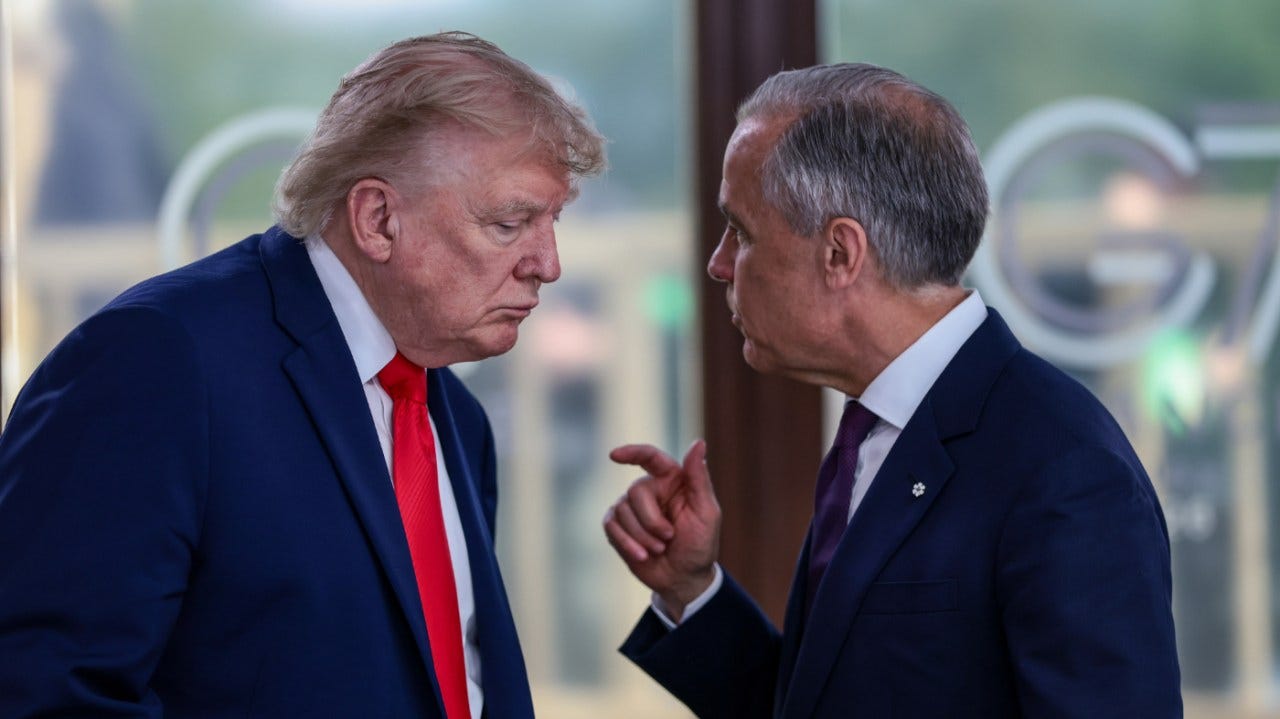
Lately, American politics is most often described in terms of “Lucy’s football,” evoking a recurring sight gag in Charlie Brown comic strips, wherein the hapless protagonist Charlie Brown takes a running start to punt a football held in place by Lucy, only for her to yank it away at the last moment. It is an accurate comparison, but that’s the problem: the position that America places both its enemies and its own partners is no joke.
In fact it more closely resembles Aesop’s fable “The Wolf and the Crane.” If you’re not familiar, it begins with a wolf who, while dining on its most recent prey, manages to get a bone stuck in its throat. The wolf howls and begs for aid from the other animals, but, none of them wanting to become its next meal, keep far away. Finally, a crane asks the wolf what’s causing such distress, and the wolf begs the crane to remove the bone. When the crane hesitates, the wolf promises a great reward. The crane accepts the offer, and reaches her head into the wolf’s throat. She seizes the bone with her slender beak, and pulls her head out of the wolf’s mouth. The wolf thanks her and turns to leave, but the crane asks “But what about my reward?”
The wolf, shocked at such a question, answers “But you’ve already received it, have you not? You put your head inside a wolf’s mouth, and it wasn’t bitten off!”
This has generally been America’s relationship to the rest of the world in the post-World War II period, but especially so during the second Trump administration. Take, for example, the opening of the Gordie Howe International Bridge from Windsor, Ontario to Detroit, Michigan. The entire cost of the C$6.4 billion crossing was borne by Canada, including the American port of entry, according to an agreement designed to let Ottawa fully recover its investment through toll revenue.
President Trump shut all of that down. In a Truth Social post in February, he threatened to block the bridge from opening, declared that the original deal “no longer stands,” and demanded that the US receive a share of the tolls. And, of course, Prime Minister Mark Carney (long since having the juice from his Davos speech knocked out of him) ultimately accepted a new agreement directing half of the bridge’s net revenues, for its first 15 years, into a fund solely controlled by the United States. Carney insisted that Canada would first be repaid for construction, but the new written agreement has no such condition. It defines net revenue as bridge revenue minus operating costs, with no deduction for Canada’s debt or up-front investment. And to hear Trump boast about the completed deal, Canadians ought to be glad for any toll revenues at all.
This, after once again using the ghost of NAFTA as political leverage. In 2017, Trump imploded the free trade agreement, threatening repeatedly that the US would withdraw from it altogether. During the process of its renegotiation, Washington imposed “national security” tariffs on Canadian steel and aluminum. Faced with catastrophic damage to its export economy, Canada loosened protections on its dairy, poultry and egg markets, and accepted new restrictions on dairy exports. It also agreed to a 16-year sunset clause, with reviews every six years allowing for the whole agreement to be reopened and renegotiated. Trump signed the replacement agreement he wanted in 2018, but even during the Biden administration, Canadian dairy management policy was repeatedly attacked by Washington.
And then Trump was re-elected in 2024. Not long after his 2025 inauguration, he promptly went on a tariff warpath with the rest of the world. Canadian goods were subject to a 25 percent tariff, initially including goods that complied with USMCA (although compliant goods were exempted days later, as the tariffs threatened the integrity of American automotive supply chains). Separate steel, aluminum and automobile tariffs persisted as a matter of “national security,” as the minuscule amount of fentanyl that could be traced through the US’s northern border was somehow enabled by the import of these goods. After another months-long squabble (and the end of Justin Trudeau’s term as Prime Minister) Canada removed most of its retaliatory tariffs in September, on the basis that most USMCA-compliant goods would remain protected.
And then the mandatory review date arrived with an entirely predictable outcome. On July 1, 2026, the United States refused to renew the very agreement Trump had negotiated, leaving it in force while Washington opened new talks over its “shortcomings.” Lather, rinse, repeat. Negotiate a new deal with the US, only to wind up staring down the barrel of a new batch of threats, tariffs, and negotiations ultimately purposed to massage the ego of Donald Trump and his coterie of court eunuchs.
What is most galling about the latest batch of tariffs (which extend to 60 of America’s trading partners) is its justification: elimination of forced labour in the supply chain. The United States itself has allowed private companies to reap enormous profits from compulsory prison labour, with federal prisoners working for mere pennies an hour. Canada, having agreed to a prohibition on goods produced with forced labour (as part of the USMCA agreement), was hit with a 10 percent tariff on non-exempt goods anyway. The excuse, much like the previous flimsy accusation of fentanyl trafficking across the US border, was that Canada is failing to enforce the prohibition effectively. And the irony here is not only that Canada agreed to the prohibition as a means of stemming the flow of Chinese goods into North America, Canada also sabotaged its relationship with China by arresting Huawei executive Meng Wanzhou on the US’s behalf (ultimately due to the US’s sanctions regime intended to starve Iran), and adopting a Parliamentary motion that China was carrying out a genocide against Uyghurs in Xinjiang.
And where did that ultimately place Canada? Once again at the whims of an increasingly unstable and borderline senile President, backed by a cabinet, Congress, and Supreme Court who act as his enablers rather than structural brakes on his power, and with most of the Canadian economy tied up in the broader fortunes of US policy. To put it another way, in 2023, 57 percent of Canadians held a favorable opinion of the United States, compared with 14 percent for China.
This year, China leads by 44 percent to 33.
Whether Trump’s mandate survives the midterm elections (assuming the US even holds midterms at all) is immaterial at this point, as is the foreign policy perspective of the next presidential administration. The US isn’t bound by handshakes, contracts, or any recognizable court system outside of the Supreme Court that Trump successfully stacked during his first administration. Canada’s fatal dependence on its relationship with the US is a lesson to the rest of the world that tough talk is cheap, but true sovereignty has a cost. It comes at the expense of energy corridors, industrial capacity, a healthy labour force, and alternative trading partners that allows a country so deep within the US orbit to survive saying no. Until Canada (as well as the rest of the US’s trading partners) can build that ability, whichever wolf sits in the Oval Office is always at liberty to see it as payment enough that their heads weren’t bitten off.